about Adam Scott Neal’s electroacoustic music
This page is about my work for performers with electronic music. Forthcoming are pages about my video art works and dance scores.
I like putting electronic sounds alongside live performers without necessarily making the two interact. What started as a practical consideration has essentially become my “approach” to music for soloist with electronics. I’ve come to think of electronics (whether fixed or live) to be a kind of environment around the performer.
The electronic sounds in these pieces tend to be atmospheric, but not completely clean or smooth. Some sounds are synthetic, but most often I derive sounds from instruments or natural, evolving sounds like rain and water.
My fixed media works make use of this “backdrop” approach in different ways:
- In Brother, the tape part is built from a single note of the baritone saxophone, while the soprano saxophone part is derived from its harmonics.
- Petrichor features a clarinet playing over recordings of rain that are granulated and filtered, turning a familiar sound into something more abstract.
- Tidal brings piano and electronics together through juxtaposing equal-tempered piano with just intonation sine waves (which create “difference tones” that inform the harmony).
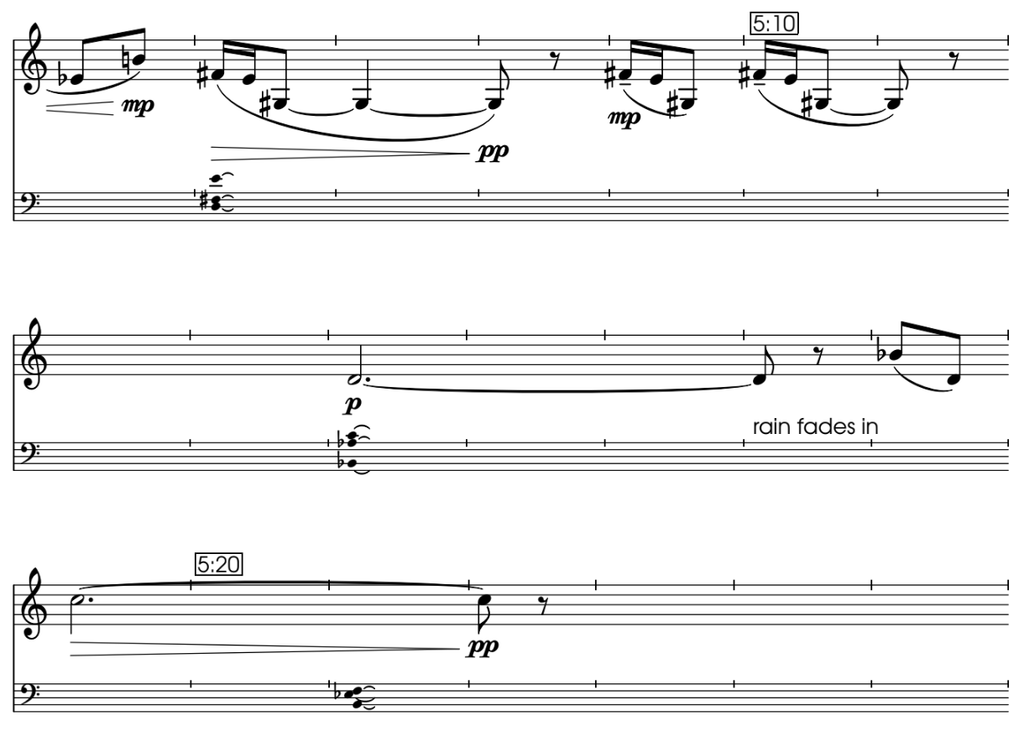
My pieces with live electronics use simple—even obvious—means to extend the sound of the soloist:
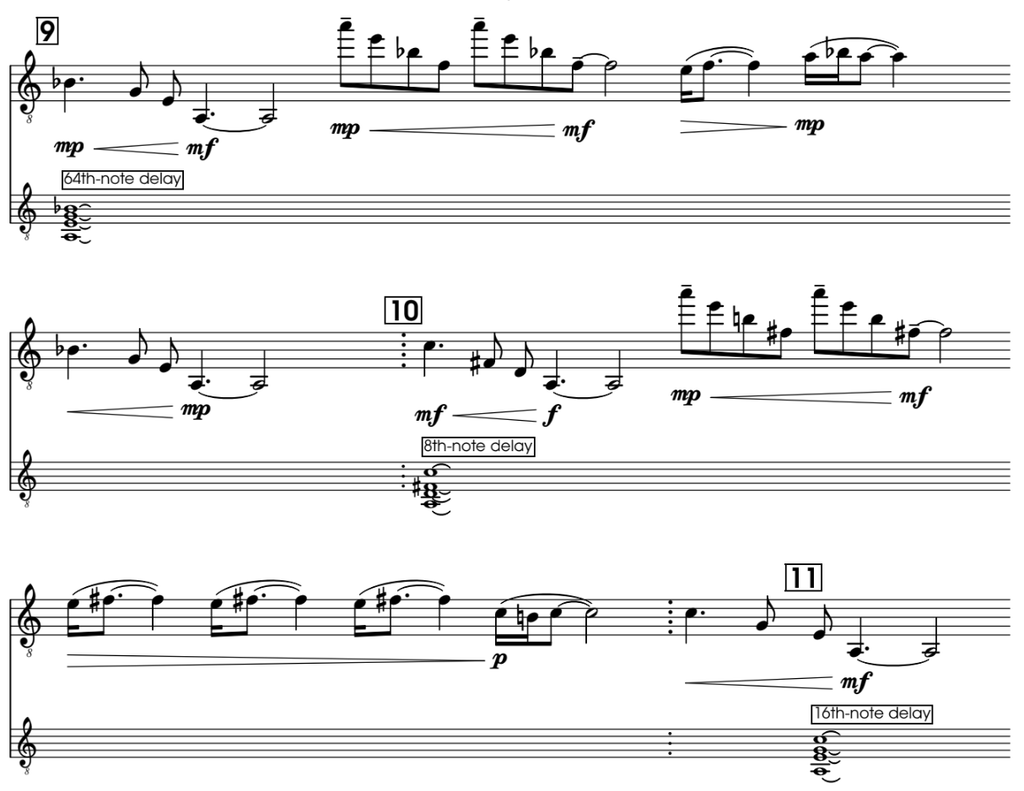
- In cords, the guitarist controls delays whose speeds change according to the consonance or dissonance of their harmony.
- In Terminal Moraine, the computer loops every second phrase, so the music gradually accumulates into undulating chords. The performer gradually adds more “preparations” to the vibraphone to make it increasingly noisy.
These electronic backdrops emphasize accumulation, ebb and flow, and slow reveals rather than continual activity. The performer often plays with a stopwatch for general timing, but exact precision is not required. I’m interested in electronics as a way of creating a “second presence” that doesn’t compete with the soloist, but is still essential to the experience of the work.
–Adam Scott Neal, October 2026